Calendar & News
This article originally appeared in " 80 Years of the PvdA – Standing on the Shoulders of Giants" | ROOD ANNIVERSARY ISSUE
After a long night, the train pulls into the station in Kyiv. The sun is shining brightly, and the temperature is pleasant. Nothing this morning suggests that, just over 24 hours ago, bombs struck apartment buildings throughout the city. While Putin talks of peace, 21 people are killed.
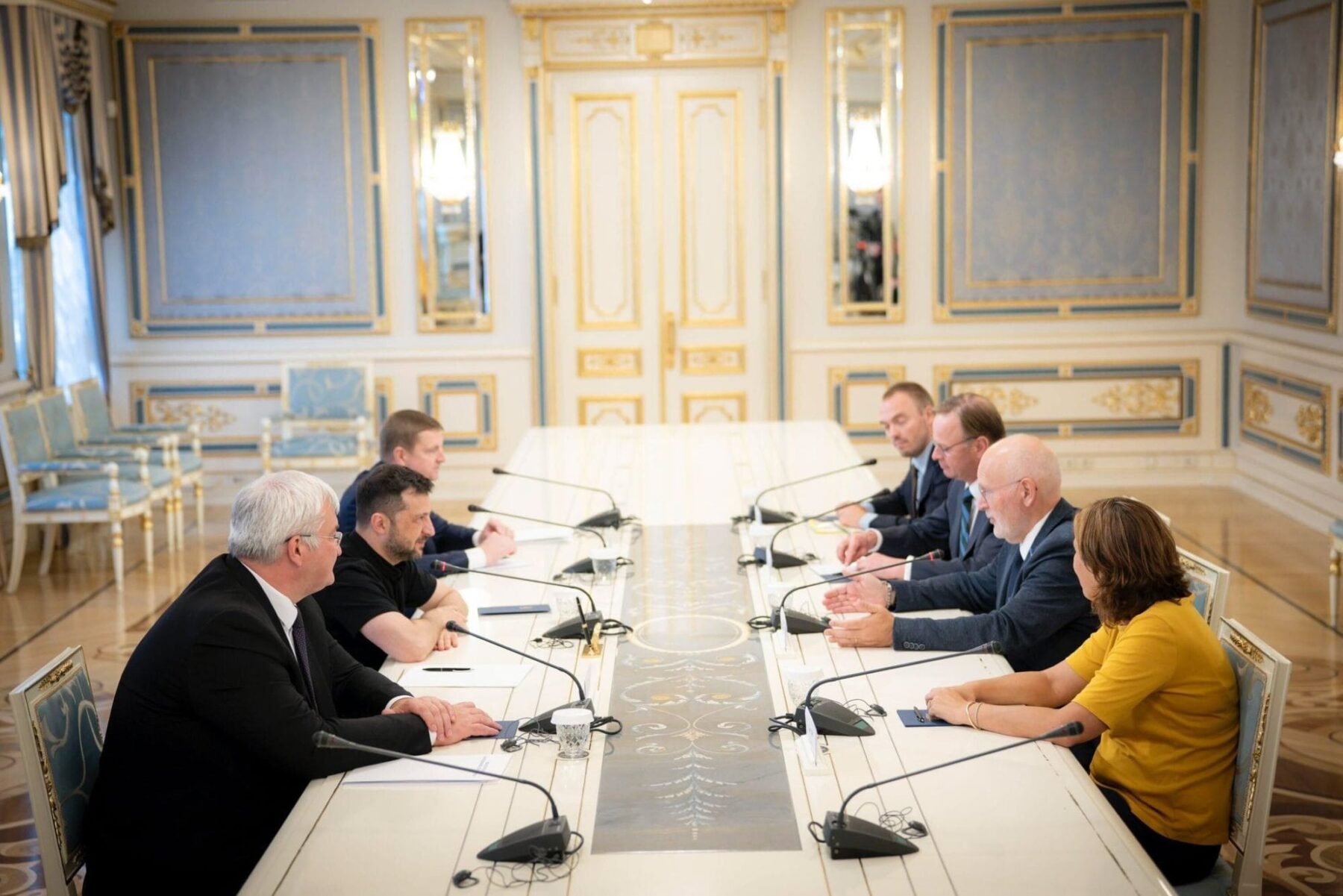
It is August 2025, and together with Frans Timmermans and Kati Piri, I have traveled to the Ukrainian capital for a meeting with President Zelensky. I’m nervous, but Frans doesn’t seem the least bit nervous. On the way here, he’s already been telling stories about trips he took in the past with his political mentor, Max van der Stoel.
I’ve sometimes compared working for the PvdA to playing soccer for the current Ajax team. You try your hardest, but you’ll never reach the level of Cruijff or Van Basten. For people who are passionate about our party’s international work, Van der Stoel is of Cruijff’s caliber (perhaps the quieter version). During his tenure as a minister in the Den Uyl cabinet (’73–’77), he played a role in the creation of the Helsinki Accords.
“I feel as though I have… lived in the shadow of the Helsinki Process,” Van der Stoel said on the twenty-fifth anniversary of the agreements. While the agreements did perpetuate the status quo of a divided Europe—a key demand of the Soviet Union—they also included a passage on human rights. This passage served as a tool to hold regimes accountable and later proved crucial in the dismantling of communism.
When you go on vacation abroad, the first thing people often bring up is Dutch soccer players (there’s Cruijff and Van Basten again), but in Prague or Athens, there’s a good chance the name Van der Stoel will come up. Much to the displeasure of the communist regime, he met with Jan Patočka of the Charter 77 movement in 1977. Never before had a foreign dignitary had the courage to do this. The memory of Van der Stoel lives on in the Czech capital, with a monument and a city park named in his honor.
Back to Kyiv. After a brief stop at our hotel, we’re picked up for our meeting with Zelensky. The president’s office is located in the middle of a residential neighborhood in the city. We pass through four checkpoints before reaching the building. The windows are covered with wooden panels, and large sandbags are stacked inside. The foyer where we’re asked to wait, on the other hand, is overly lit; fake gold and large mirrors are meant to give the space a presidential air.
Sometimes there are moments in life when you know something special is about to happen. I’ve heard stories from my predecessors about extraordinary encounters. Jan Marinus Wiersma, who, along with Maarten van Traa, was one of the party’s longest-serving international secretaries, told me, for example, about Nelson Mandela’s visit in 1990 to the PvdA Party Council at the Meervaart in Amsterdam. The freedom fighter’s visit had been arranged just a few days earlier by Wim Kok during a meeting of the Socialist International in Bonn, Germany. Mikhail Gorbachev’s visit in 2003 to the PvdA convention in Groningen also captures the imagination. This moment fits right into that list.
Zelensky takes plenty of time to meet with us. He has extraordinary charisma and infectious energy, but even that can’t hide the deep bags under his eyes. And how could it be otherwise: for nearly four years now, he has been steering his country through the war and traveling the world to gather support. Halfway through our meeting, he picks up a piece of paper and sketches out the situation on the front lines. “This here is the death zone.” It’s a zone about 10 kilometers wide where anyone who sets foot in it is immediately attacked by drones. Modern warfare is just as brutal as it used to be.
Afterward, one of Zelensky’s staff members is waiting for us. As one of the founders of the SD platform—a platform of activists committed to a just future for the country—he first came into contact with the work of the Max van der Stoel Foundation about ten years ago. “I will never forget what your party has done for us.” It makes me proud.
After the Fall of the Wall, our party, together with the Alfred Mozer Foundation (which merged with the Evert Vermeer Foundation in 2013 to form the Max van der Stoel Foundation), played an important role in supporting sister parties in Central and Eastern Europe. Many of these parties are still represented in the Party of European Socialists and Democrats (PES), which was founded in The Hague in 1992 under the leadership of Wim Kok.
On the way back in the van to the Polish border, we’re mostly silent. Exactly fifty years after the Helsinki Accords, the challenge ahead of us suddenly seems very daunting: how are we going to prevent Ukraine from giving in, and can we, as Europe, survive in a world where the law of the jungle increasingly prevails?
If the history of our party teaches us one thing, it is that the struggle for justice requires patience—and perhaps a healthy dose of naivety. How else would we have managed to bring Mandela and Gorbachev to the Netherlands or to place an emphasis on human rights in Helsinki? Because those who stand up for principles in a world of brute force—whether they are brave Ukrainians or defenders of justice elsewhere—deserve our support. Let’s make that the mission of the new party.