Democracy
In late October, a seven-person delegation from the European Forum for Democracy and Solidarity (EFDS) visited Georgia. The group consisted of members of parliament from various European countries and representatives of political foundations. The focus was primarily on Georgia’s foreign policy, following up on the EU Commission’s recommendations, and holding discussions with and assessing the relationships between civil society actors and political parties. In addition, our delegation assessed the key challenges related to the parliamentary elections scheduled for October of this year.
The Significance of Our Visit
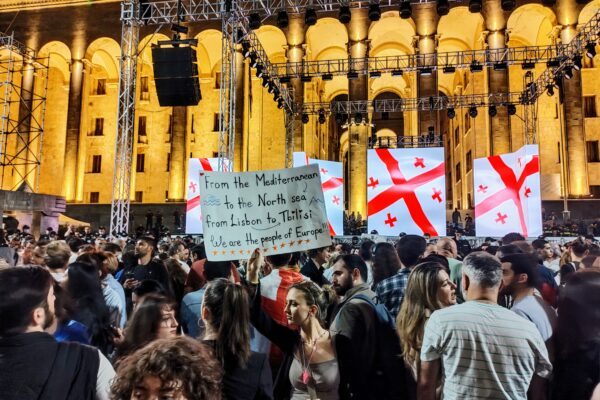
It is important for the EFDS to build knowledge about the challenges Georgia faces in the area of democratic development. Although the country initially took significant steps toward becoming a full democracy, progress in some areas has stagnated or is regressing. Over the past ten years, it has become increasingly difficult for the opposition, activists, and NGOs in the country to operate. State interference in government institutions and the media, as well as election fraud, have led to distrust in the government and large-scale protests, particularly in March 2023. The normalization of relations with Russia has raised further concerns about the country’s commitment to both democratic values and transatlantic loyalties. At the time of the EFDS visit, Georgia was still in the process of obtaining EU candidate status; in December, the country officially became a candidate. If Georgia meets the strict conditions for EU membership, it can move toward democracy and away from Russia.
Another important part of the mission was establishing contacts with organizations in Georgia. There are several social democratic and progressive foundations in the country that could benefit from building a network. The EFDS visited several such organizations to assess whether future collaboration is possible. The main goal is to promote cooperation among EFDS organizations and to launch projects in Georgia that help progressive actors address domestic sociopolitical challenges.
Russia’s invasion of Ukraine has reinforced the belief among some Georgians that reconciliation is the best strategy to prevent a war with Russia. Within Georgian political discourse—which was already heavily focused on relations with and the potential threat from Russia—the conflict has placed even greater emphasis on the question of how to deal with Russia. Differences of opinion on security issues are a major source of discord between the GD and the UNM. They have led to further polarization and have had a negative impact on Georgia’s democratization process.
Findings and Recommendations
The political strategy of the ruling Georgian Dream (GD) party is key to understanding the current political situation in Georgia. In recent years, the party has shifted from socially oriented policies to a more repressive, power-hungry strategy. The“foreign agents”law is a notorious example of this, but there are many more instances in which political institutions are being undermined by the ruling party. The legitimacy of Georgian politics is quite low due to the role of opaque funding streams, entrenched business interests, and personal feuds. The barrier to entry for new parties seeking to break the bipolar political “status quo”—with GD and UNM as the main parties—is quite high. However, if a third political force were to emerge, it could lead to greater political pluralism and less party-driven legislation. In addition, there is currently a lack of effective communication between civil society organizations and political parties. If this improves, it could help new political parties gain institutional knowledge, mobilize people, and increase their support.
Under the GD’s rule, civil society in Georgia has also come under increasing pressure. The GD’s ongoing attacks have been particularly harmful to vulnerable groups such as the LGBTQI+ community. It is important that the EU monitor violations of minority rights and impose consequences for them within the framework of Georgia’s EU accession process. The media landscape in Georgia is largely dominated by the ruling GD party, which uses it to spread its political message. There are worrying signs that the media are not functioning as they should in a fully-fledged democracy. A pluralistic and impartial media landscape and independent journalism would help combat political polarization and lay the foundations for democracy.
The elections this October will be a pivotal moment for the country in several respects. It will become clear which direction the Georgian government is heading with regard to accession to the European Union. GD will face off against its main rival, the United National Movement (UNM). The two parties are bitter rivals and base their identities on opposition to one another. The elections will therefore also serve as an important barometer of the political polarization stemming from the struggle between the two parties.