Democracy
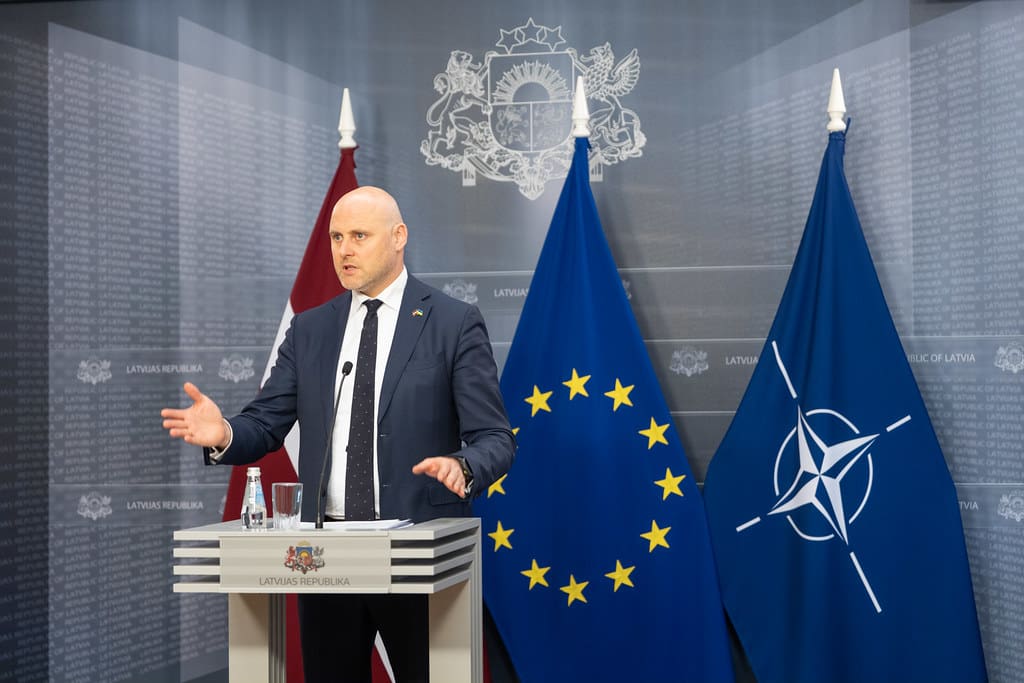
Photo: Election winner Andris Kulsbergs in June 2026
Last Saturday, October 3, Latvians cast their ballots in the elections for the 15th Saeima, the national parliament of the Baltic state. Former Prime Minister Evika Siliņa resigned earlier this year in May following a political crisis caused by Ukrainian drones that struck Latvian territory after being diverted off course by Russian electronics. However, Latvia remained stable in the run-up to the elections and weathered the expected unrest and (successful) Russian interference following the government’s collapse. This was not the first Russian attempt at destabilization that Latvia has faced, and the country was well prepared. What does Russian disinformation in Latvia look like, and what can other EU member states learn from Latvia’s digital struggle?
Historic Elections
First, the election results. Current Prime Minister Andris (United List) won the election by an overwhelming majority, securing 35% of the total vote—a historic high never before achieved by any party since Latvia’s independence. When Siliņa stepped down as prime minister, Kulbergs (United List) took over. Since then, he has been very active on social media, where he presents himself as an ordinary Latvian who can also act as a decisive leader.
Since Latvia has a 5% electoral threshold for entry into parliament, the United List will hold 41 seats in the Saeima, which has a total of 100 seats. Kulbergs is known for his pro-Ukraine and pro-EU stance, which puts him at odds with populist parties such as Latvia First and Sovereign Power/Young Latvians; they finished in second and third place behind United List, with 13% and 11.7% of the vote, respectively.
However, Kulbergs’s landslide victory was not the only historic aspect of the election: voter turnout was the lowest ever in the history of Latvian democracy. Only 51.79% of eligible voters participated in the election, with 806,641 citizens casting their ballots. This is in line with a trend that began with the first elections following independence in 1993, when voter turnout stood at 89.9%.
Security, the Economy, and Relations with Russia During the Campaign
As expected, the election campaign centered on security and defense, underscoring the precarious international situation in which Latvia finds itself. The Baltic states form NATO’s eastern border—a position of great geopolitical importance that has been further reinforced since Russia’s invasion of Ukraine. Security, however, was not the only major issue; economic and social issues also featured prominently.
Debates on security were not limited to investments in defense or diplomacy; party leaders’ personal ties to Russia and Belarus were also a hot-button issue. During the campaign, the Riga-based online news site “The Insider” discovered that Jūlija Stepaņenko, leader of Sovereign Power/Young Latvians, has questionable family ties. Her father, Sergej Fedotov, is the majority shareholder of two Russian family-owned companies that have been directly linked to military equipment deployed in the Donbas and Belgorod regions. Fedotov is said to have spoken with Russian arms dealer Viktor Bout, who advocated for the removal of bureaucratic obstacles in Russia—a country that, according to him, finds itself “sometimes in a hybrid war and sometimes in an open war.” Other parties have called for an investigation into Stepaņenko.
Aleksejs Rosļikovs, party leader of For Stability! and a resident of Belarus, also participated in the elections. Rosļikovs had fled to Belarus after being accused of inciting national and ethnic hatred. Although he is on the wanted list in Riga, he still lives in Minsk, where he presents himself as a martyr and claims that he and his family are being threatened in Latvia. From Belarus, he attempts to undermine the Latvian government, for example by comparing gas prices in Belarus and Latvia. “For Stability!” failed to clear the 5% electoral threshold.
People’s Power Force—though a registered political party, it is not eligible to run in parliamentary elections—called for a so-called “wise boycott.” They argue that elections with a turnout of less than 50% are not legitimate and are calling on citizens not to vote. In their view, oligarchs and politicians have stolen the power of the people, and voting would only legitimize the regime. Their mission is to “protect the people of Latvia” and “stop the extinction of the Latvian nation”; they demand the abolition of state funding for political parties and advocate for new elections. According to their website, 43,692 people joined the boycott, including 12,219 “non-citizens” and 7,262 anonymous participants.
Narratives and Frames
Common narratives spread by Russian disinformation networks target the EU or NATO. “These narratives are designed to undermine the capabilities or legitimacy of these organizations,” says Anete Bērzkalne in an interview with PRO International. Bērzkalne works as a disinformation expert at the Latvian Radio News Service and contributes to investigative journalism, specializing in Europe.
“On the one hand, the EU is said to be too weak. On the other hand, it is said to be too focused on Brussels, which would turn Latvia into a kind of puppet state of the EU.” NATO is portrayed in a similar light: the transatlantic organization would either be unable to help Latvia or act too aggressively toward Russia. The Baltic states are also often accused of the latter. Other narratives claim that Latvia’s decisions are naive, incompetent, or idiotic.
Russia also targets specific groups, particularly ethnic Russians living in Latvia. This group makes up about 25% of the Latvian population, making it the largest ethnic minority in the country. Russian sources claim that the Russian diaspora is being oppressed. In recent years, the use of the Russian language in Latvian education has declined, a trend that Russia is using to reinforce its narrative. Just as with the rhetoric used to legitimize the illegal invasion of Ukraine, the Kremlin is quick to use the term “Nazis” in its framing of the alleged oppression of Russians, says Bērzkalne.
How does Russia spread disinformation?
On July 31, Bērzkalne interviewed Jānis Sārts, director of the Riga-based NATO Strategic Communications Center of Excellence (STRATCOMCOE). He discussed various hybrid attacks that Latvia might face during the elections, including the malicious misuse of AI, as well as drone and cyberattacks. His concerns proved to be well-founded, although the state security services reported that while cyberattacks were detected, they did not have a significant impact on the elections.
That does not mean, however, that no attempts have been made. For example, two researchers monitored AI responses to questions about the elections, including which political party the language models recommended. Depending on whether the question was asked in Latvian or Russian, the answers and the linked sources varied significantly. When the question was asked in Russian, the AI models (ChatGPT, Gemini, and Claude) used suspicious or even banned websites as sources, such as “Sputnik News.” The models also recommended different voting choices, favoring parties such as “For Stability!”, “Sovereign Power,” and “Union of Young Latvians.” The latter two, led by the aforementioned Stepanenko, were mentioned twice as often as when the question was asked in Latvian.
The Latvian television program “De Facto” monitored pro-Kremlin media and discovered that political candidates who supported Ukraine and sanctions against Russia were often ridiculed. On the other hand, candidates who, for example, criticized restrictions on the transit of Russian grain were actually given preferential treatment. Since one in three Latvian internet users employs AI, it is becoming increasingly attractive for Russia to manipulate these models by flooding the internet with Kremlin-friendly content.
Social media provide key platforms for disinformation, particularly TikTok and Telegram, according to Bērzkalne. “Stories that first spread through other digital channels can then spread further via social media platforms.” The nature of the destabilization efforts depends on the platform. For example, Telegram is also used to recruit people for acts of sabotage, while X shows more bot activity.
After the elections, Varis Teivāns, head of the Latvian Institute for Cyber Incident Prevention, told Latvian radio that cyberattackers were attempting to create websites with domain names similar to those of popular Latvian news sites, likely with malicious intent. They also tried to find vulnerabilities in the digital environment, not only in election systems but also in the systems of local governments and other government agencies. He acknowledged that more attacks were predicted but declined to speculate on whether the high level of preparedness and investment had deterred potential attackers.
The Fight Against Russian Digital “Hybrid” Warfare
Although it is difficult to say why the intensity of the attacks was lower than expected, it is clear that Latvia is fighting back. In January of this year, an inter-institutional group was established to prevent security threats to the parliamentary elections. This group consists of institutions involved in electoral processes, the state security services, and cybersecurity. In addition, pro-Kremlin parties have been subject to preventive monitoring since 2025. On the recommendation of the VDD (the State Security Service), 400 Russian propaganda websites have been blocked in Latvia since the invasion of Ukraine. In 2022, 80 Russian media outlets were banned in a similar manner. Campaigns against disinformation were launched to educate voters about their role in the elections, how to recognize disinformation, and how to prevent themselves from spreading it further.
In her work, Anete Bērzkalne also seeks to raise awareness about disinformation and how it works—specifically, how malicious narratives and frames are designed to foster apathy, distrust, and dissatisfaction: “The main goal is to discourage people from voting or to encourage them to vote for parties that are more pro-Russia,” she explains. “Every time we uncover disinformation campaigns, it’s a difficult decision. Do we tell the public about it, and if so, how and when? The goal of disinformation is often to sow fear; we don’t want to contribute to that.” She cites an example from TikTok, where it was claimed that a Russian election or referendum on the annexation of Latvia would take place in January. “It was completely fake, but it looked very frightening. That’s why I didn’t publish it until quite some time later.”
When asked what other EU countries can learn from Latvia’s fight against Russian hybrid warfare, she emphasized how important it is to understand how disinformation works and what the various intentions are behind the spread of false narratives. “Narratives may seem contradictory, but they serve the same purpose: to sow division among Latvians themselves, or among EU or NATO member states.” She concludes: “We analyze the impact of hybrid attacks and what their objectives are. For example, is the goal to instill fear or to collect data? Do not underestimate the devious methods Russia employs.”