Democracy
Photo source: Wikimedia Commons
Since Georgia gained independence from the Soviet Union in 1991, the country has experienced a history of revolutions, war, and protests, but also hope for democratization. Today, however, that hope is fading with every day that the Georgian Dream regime imprisons protesters and politicians, seeks to ban opposition parties, and undermines civil society financially and legally. PRO International spoke with Georgian colleagues, all of whom continue to fight in their own way for democracy, freedom, and a European future. They discuss Georgian Dream’s strategy and how the regime aims to isolate Georgia from Europe. According to them, this is precisely why the international community must stand in solidarity in the fight for democracy.
From Soviet State to EU Candidate
Like many other neighboring countries of the former Soviet Union, Georgia gained independence in the early 1990s. On March 31, 1991, 99.1% of voters voted in favor of independence. However, Georgia has been unable to shake off Russian influence to this day. A former Soviet minister became prime minister and led the corrupt government until 2003, when the so-called “Rose Revolution” took place.
Following the “Rose Revolution,” rebel leader Mikheil Saakashvili came to power. Georgia entered an era of modernization and rapprochement with the EU and NATO. However, this period was also marked by serious concerns about human rights, which culminated in November 2007 in a violent crackdown on protests and Saakashvili’s subsequent resignation. He was later re-elected. In 2008, Russia invaded Georgia; a war that ended with the occupation of Georgian territories and their de facto annexation by Russia.
In 2012, Bidzina Ivanishvili, Georgia’s richest man, stepped out of the shadows of power. With lofty promises and a dream of a restored, strong Georgia, he managed to rally many people behind him—and behind his newly founded party: Georgian Dream. Ivanishvili became Georgia’s prime minister, and not long after, Saakashvili resigned as president. Georgian Dream seeks to maintain friendly relations with both Russia and the EU on the international stage, although many Georgians are more inclined toward European cooperation. Seventy percent of Georgians want to join the EU, and 60% believe that membership should not come at the expense of trade with Russia. Nevertheless, Georgian Dream enjoys strong support among the population: 80% view Ivanishvili favorably, and 63% say Georgian Dream is the party that best represents their views.
Georgian Dream has remained in power continuously since 2012. Ten years later, they submitted a request to the EU to begin the accession process. However, little has come of the list of requirements from Brussels that was supposed to finally make the European dream of many Georgians a reality. On the contrary, the autocratization of the Caucasian state—which may never have been a full democracy to begin with—really gained momentum after 2022.
Thanks to the analyses provided by our Georgian colleagues, in the following paragraphs we offer a glimpse into Georgian Dream’s playbook: how they first attempt to crush civil society, then crack down on the ensuing protests, and now also seek to ban opposition parties. It is a step-by-step plan with the ultimate goal of completely isolating Georgia from Europe, with Georgian Dream as the sole ruling party.
Anti-Espionage Act
In May 2024, freedom of speech will be severely curtailed when the parliament—in which Georgian Dream holds an absolute majority—passes the “Foreign Agent Law.” The law, which bears a striking resemblance to Russian anti-NGO legislation, requires nongovernmental organizations to register as “foreign agents” if they receive more than 20% of their revenue from foreign grants. Under the guise of countering foreign interference, the regime aims to make the work of NGOs virtually impossible through this law. “In English, the term ‘foreign agent’ might still sound reasonable,” explains Dimitri Tskitishvili, a former member of parliament who now works for the Georgian Progressive Forum. “But in Georgian, it means nothing less than ‘spy.’”
The Georgian Progressive Forum advocated for labor rights and social policy. Until recently, in addition to its other activities, it also carried out joint projects with government agencies, including state institutions. At least, that was the case until four years ago; the vast majority of its activities have now come to a standstill. “We do not want to comply with this undemocratic law. If we were to follow the rules and register as a ‘foreign agent,’ we would effectively be held hostage,” says Tskitishvili. His organization’s activities are now primarily carried out on a volunteer basis.
The Georgian Progressive Forum is not the only organization that has been severely affected by the law. Many organizations have fled abroad, suspended their activities, or disappeared altogether. Their employees are fleeing to EU countries; some face a much worse fate if they remain in Georgia. Violations of the law can even lead to prison sentences. Georgia’s civil society is highly dependent on international funds and grants. Without an independent and diverse civil society, there is no organized movement to hold those in power accountable. And that is precisely the goal of Georgian Dream.
Protests, police violence, and parliamentary elections
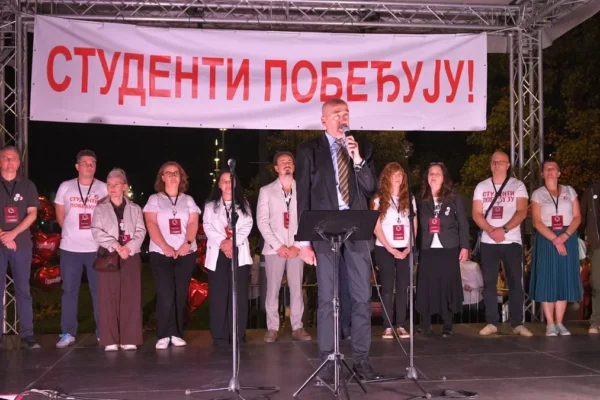
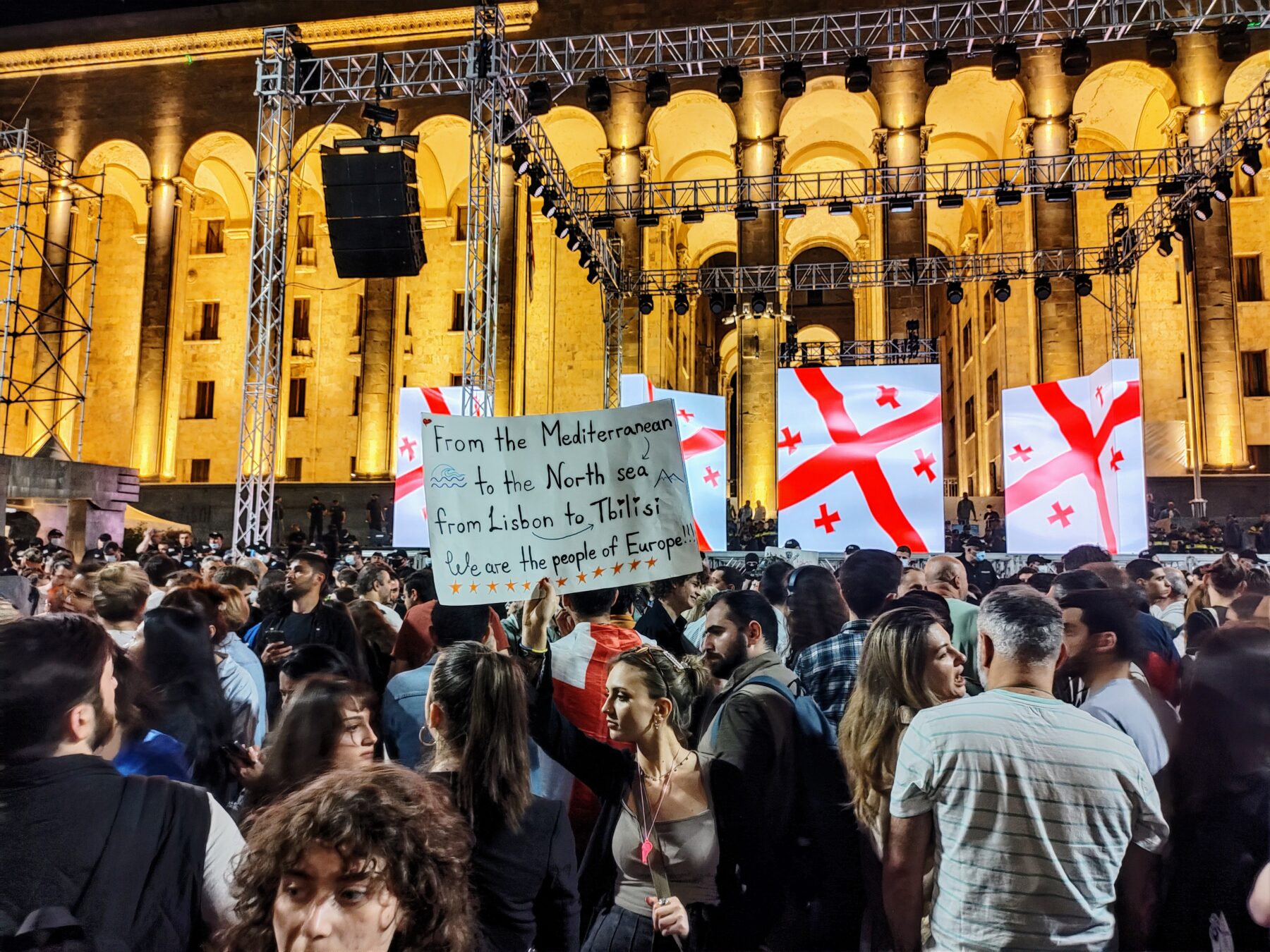
In fact, due to the “Russian Law,” the streets of Tbilisi are once again filling with protesters throughout 2024. The mostly young protesters gather en masse in front of the parliament building; wrapped in EU flags, they rally there for their European future. This does not prevent Georgian Dream from winning the parliamentary elections in October 2024 as well, despite widespread evidence of fraud documented by both local and international election observers. When Prime Minister Irakli Kobachidze announces a month later that he will not proceed with EU accession for the time being, the protests reach a peak. It becomes clear that Georgian Dream’s rapprochement with the EU was merely a campaign ploy. Now that actual obligations regarding democracy and human rights are involved, it has become more of a burden.
The larger the protests grow, the more violently the police crack down on them. More than 460 protesters have been arrested, and more than 300 of them report having been subjected to abuse or even torture during their arrest and detention. Not only protesters but also opposition politicians are being imprisoned, says Giorgi Gotsiridze. Gotsiridze works for the Georgian Young Lawyer Organization, once Georgia’s largest civil society organization, but in recent years they have been forced to reduce their staff from 60 to 10. Perhaps worst of all is that, even at this size, they remain one of the most active NGOs in the country. “There are many so-called sabotage charges brought by the regime against politicians who publicly support the protests,” Gotsiridze continues. “The police claim that protesters tried to infiltrate the parliament building. Georgian Dream is using this to accuse opposition members of sabotage against the state.”
Ban on Opposition Parties
That accusation is often used to silence opponents of the regime. This marks the next step in Georgian Dream’s plan: neutralizing the opposition parties. In October 2025, the regime announced that it was taking three opposition groups to the Constitutional Court on charges of“disrupting theconstitutional order.” Since then, every time the Constitutional Court’s deadline has drawn nearer, new opposition parties have been added to the list, causing the trial to be postponed time and again. This brings us to last month, when the opposition party For Georgia was added to the list. Although this may sound like yet another attempt by Georgian Dream to silence the opposition, this latest addition is particularly striking. For Georgia is, in fact, the only opposition party that has actually taken its seats in parliament. The other opposition parties are boycotting parliament because of the unfair 2024 elections.
Georgian Dream Strategy
Opposition parties are also accused of provoking Russia. In Georgia, there is a daily fear that the country will become the next Ukraine—a fear that Georgian Dream is only too happy to exploit. Anything that comes from abroad is framed as foreign interference, whether it originates in Russia or not. Every step toward the European dream shared by so many Georgians is spun by the government as a provocation against Russia. In this way, any rapprochement with the EU is paralyzed. Georgia thus isolates itself further and further, which is exactly what Georgian Dream wants. The fewer onlookers, the less challenge to their political power. “Georgian Dream wants to create a sense of nihilism: nothing we do could change the situation,” says Tamar Kekenadze, a member of the political council at For Georgia.
Kekenadze views the lawsuit as an attempt to ban opposition parties and silence critical voices. Georgian Dream is now also making it clear that the purpose of the lawsuit is to make room for new “healthy” opposition parties—a promise previously made by Ivanishvili in 2024. Furthermore, the lawsuit can be used as a bargaining chip in negotiations with the EU or the United States. Georgian Dream is well aware of the European dream held by many Georgians, including its own supporters. The regime can use the lawsuit in negotiations to maintain the appearance that it is making democratic progress in its rapprochement with the EU. Interestingly, in separate interviews, Tskitishvili, Gotsiridze, and Kekenadze all viewed the lawsuit in exactly that way: as an almost desperate attempt by Georgian Dream to consolidate as much power as possible, while simultaneously satisfying their own supporters, the EU, and Russia. Tsikitishvili even described the regime as weak; it remains in power only because the opposition is even weaker. “Georgian society must prepare for the elections. They will not be fair, so as many people as possible must be mobilized. The regime will collapse as soon as the protesting public becomes strong.”
Preparing for Elections
In October 2028—just under two years from now—parliamentary elections will be held again in Georgia. Many activists are already preparing for what feels like their last chance to save the country from dictatorship. Many of them have organized under the Movement for Social Democracy, a progressive movement founded after the 2024 elections. Sopho Verdzeuli, a board member of the movement, explains how they are being obstructed by the government on all fronts. “When we wanted to become a movement, the process was delayed for months by the Minister of Justice. Normally, it takes only a few days.” The movement’s primary goal was to raise awareness among the public about the disastrous consequences of a Georgian Dream election victory. “But people responded by saying there were no good alternative parties,” says Verdzeuli. Now that the regime is just past the halfway point of its term, the movement is taking matters into its own hands: it wants to become a political party. That requires a lot of time and organizational work. “First, we have to write our platform. Then we’ll build our internal structure. It’s organized horizontally; we operate on the basis of consensus. We’re also building networks of solidarity throughout the country. And now we’re going to make a real effort to become a registered party. We’ll face opposition again and run into many legal and political obstacles.” That prospect, however, isn’t stopping the activists. In fact, they aim to become a party before the end of this month.
Ticking time bomb
It will be an enormous challenge for the Georgian opposition to convince the people that Georgian Dream is not the solution to their problems or their fears. The opposition parties are divided, and civil society has been almost completely paralyzed. The Movement for Social Democracy therefore wants to take a different approach, Verdzeuli explains: “The opposition parties’ strategy was to focus on international actors rather than on the needs of Georgians. We want a different political structure, a different culture, and a new narrative.” The party, which has yet to be established, intends to focus on progressive issues, the often dire financial situation of many Georgians, and green policies. “The crisis we are currently facing is primarily caused by socioeconomic factors. The autocratic regime functions almost laughably poorly. They are unable to maintain control over both the quality of life of Georgians and the opposition. When forced to choose between the two, they will always opt to keep the latter under their thumb. If there are no civil society organizations or opposition left, then public discontent will have no platform.”
Weak regime or not, the clock is ticking. Verdzeuli aptly calls it a race against the clock: in 2028, Georgia has a chance to bring down the regime of repression, autocracy, and human rights violations. Similar situations in Hungary and, more recently, Serbia offer hope. However, Georgian Dream has also taken note of those examples. And all signs point to them not letting that time bomb tick away until 2028.
Don't leave Georgia on its own
As you read this article, Georgian Dream has, against all expectations, taken the next step in the legal case to ban the opposition parties. The hearings are now in full swing. Strong statements of disapproval from EU institutions will not stop them. Our Georgian colleagues continue to fight for Georgian democracy and the European dream. When asked individually, they all make the same appeal: “Georgian Dream wants to quietly isolate Georgia from the rest of Europe. But we belong to Europe. Don’t forget us. Fight alongside us in loud solidarity.”