Democracy
Since the collapse of part of a train station in the Serbian city of Novi Sad, which claimed 16 lives, disgruntled Serbian citizens have been taking to the streets en masse for nearly two years. At first, it was mainly students, but the protests were soon supported by a growing number of Serbs from other segments of society. Two years after the collapse, President Vučić has resigned, and elections are on the horizon.
In the run-up to the Serbian elections on October 25, PRO International presents a three-part series: Is Serbia moving back toward democracy, or has Vučić already bent the rules to his will and is driving Serbia further toward an autocracy? In Part 1, we explain how the collapse of a train station led to elections, and what is at stake for Serbians in this election.
From Collapse to Election
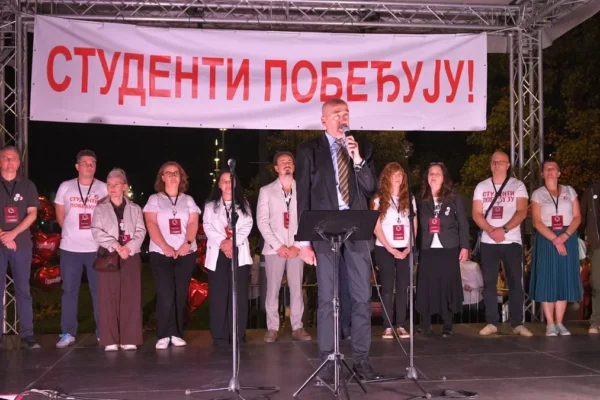
The collapse of a section of the Serbian train station illustrated to many Serbs what was wrong with their country, particularly large-scale and widespread corruption. The students had two simple demands: they wanted to see the bidding documents for the station’s renovation, and they demanded that those responsible be brought to justice. To put pressure on the institutions and the government, the students took to the streets en masse. Dissatisfaction with the government grew, and at the height of the protests, as many as 300,000 people were out on the streets in the capital, Belgrade. It didn’t stop there. Across the country, in every municipality, citizens took to the streets to demonstrate against corruption and the government, and to demand justice.
The students’ demands were not met by the responsible institutions. According to Tamara Tripić, a former member of parliament and prominent Serbian human rights activist, “none of these demands are radical, and in a well-functioning democracy, these two demands would naturally be met,” but since the institutions are completely controlled by Vučić, this did not happen. As a result, the students put forward an additional demand: elections. They saw this as the only way to achieve justice.
In late September, Vučić complied with this demand and called for early elections. However, he is not stepping down; instead, he is running in the elections himself with the goal of becoming prime minister. According to Tamara, the upcoming elections represent a crossroads for Serbia: “We must choose whether we want to continue living in this controlled state, or whether we will seize the opportunity to rebuild our country brick by brick.”
Oppression as a Strategy
Since Vučić came to power in Serbia, democracy in the country has come under increasing pressure. Most striking is the government’s significant influence over the media landscape. As a result, independent news media have all but disappeared. According to Tamara, this causes Serbs to live in “parallel realities.” Political scientist Geert Luteijn, who specializes in Serbian politics, paints a similar picture. According to him, “there is no level playing field when it comes to the media, because alternative voices have been completely silenced by the regime.”
In addition, the Vučić government is resorting to widespread violence and repression. It is not only journalists who are affected by this; as Tamara explained, “even students who are peacefully demonstrating are being intimidated and arrested.”
This strategy has already worked several times in past elections. Due to widespread oppression of the media and journalists, and the lack of a united opposition capable of defeating Vučić, many young people and progressive voters had no confidence in the elections. The students are participating in these elections themselves, with a diverse slate of candidates. Nearly the entire opposition has rallied behind the student slate. According to Tamara, this makes this election different. “We’ve never seen such a large mobilization of people going to vote; young people in particular—who normally don’t vote—now seem to be turning out.”
However, neither of them has any confidence that the elections will be fair. Tamara fears a Trump-style “refusal to concede defeat.” Geert explains that Vučić “is certainly willing to engage in widespread fraud, and that it is very important for us to address this at the international level.”
It remains to be seen what will happen on Sunday, October 25, but the massive demonstrations against corruption, against Vučić, and in support of democracy have sparked a glimmer of hope. For the first time in years, a break with the Vučić era seems possible.
The second part of this series takes a closer look at the student list’s strategy and the decisions made by other opposition parties regarding whether or not to rally behind the student list.