Democracy
This series is written in collaboration with the International Foundation GroenLinks (IFG).
EU enlargement is back on the agenda. Following Russia’s full-scale invasion of Ukraine in 2022, and amid growing uncertainty about the United States’ role in Europe, EU leaders have increasingly emphasized the need to expand the Union. Closer cooperation with countries in Eastern Europe and the Western Balkans is seen as important for the continent’s security and independence.
Yet joining the EU is a complex process. Since the reforms in 2021, candidate countries must complete negotiations across 32 policy “chapters,” grouped into six thematic “clusters.” These reforms aim to bring national laws and institutions into line with EU standards. Much attention is usually given to the so-called “fundamentals” cluster, which covers areas such as the rule of law and public administration. However, other clusters are equally demanding.
Chapter 27, on Environment and Climate Change, is particularly challenging and complex. Its requirements are aligned with the European Green Deal, which aims for climate neutrality by 2050 and therefore requires major investments, strong administrative capacity, and coordination among institutions. It also has significant social consequences for candidate countries, especially those where jobs and energy systems still depend heavily on fossil fuels.
In this series, we examine how candidate countries are addressing the challenges posed by the climate chapters of the EU accession process. We analyze their progress on reforms and focus on the complex dynamics of the green transition, democratic legitimacy, and social change. In this article, we take a closer look at a small frontrunner: Montenegro.
Current Situation
Montenegro is widely regarded as the most advanced EU candidate country at this time. The country has already closed nearly half of its negotiation chapters. In December 2025, EU member states proposed to begin drafting Montenegro’s accession treaty. According to some, Montenegro’s accession to the EU in either 2027 or 2028 is considered a realistic prospect.
Ecology has always played an important symbolic role in the country’s self-perception, says Ćazim Lisičić of the Fund for Progressive Politics (FPP). The FPP, which Lisičić describes as “the only political foundation in Montenegro” and which is affiliated with the Social Democratic Party of Montenegro, will celebrate its 10th anniversary next year—a year that could prove historic for the small country. But for that to become a reality, there is still a lot that needs to happen, Lisičić says. Although Montenegro has historically presented itself as an “ecological state” (a principleenshrined in the 2007 constitution), the issue of the green transition is rarely at the top of the agenda in day-to-day politics. Economic problems often take priority—a reality that is also reflected in Montenegro’s progress toward EU accession.
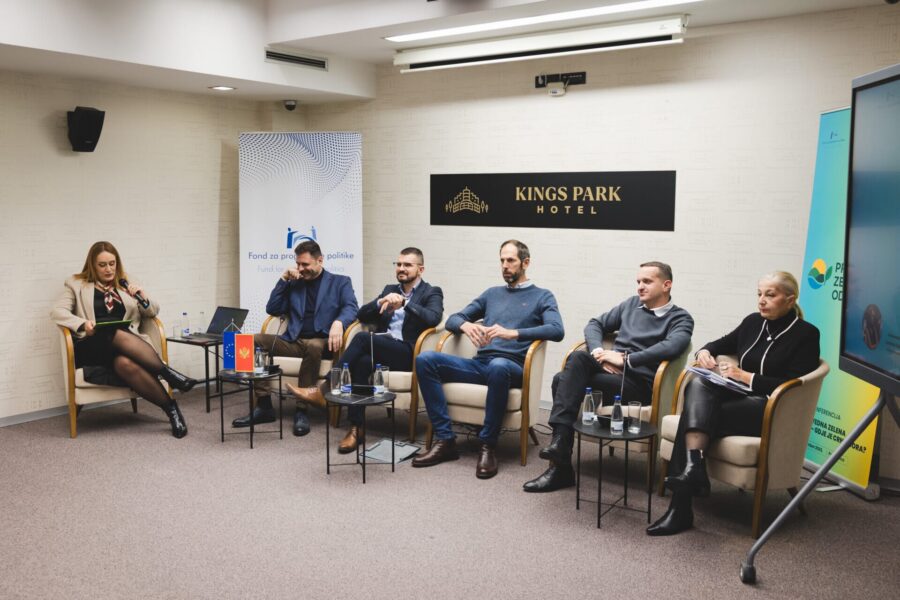
Lisičić’s FPP organized the first conference on Chapter 27 reforms last year in Podgorica.
Overshadowed
Last December, Montenegro’s parliament passed a National Energy and Climate Plan in line with EU Chapters 15 and 27, ensuring that its legal framework is in order for accession. But the country faces a clear lack of enforcement, creating a disconnect between what is on paper and what happens in practice, Lisičić says. Enforcement requires investment in capacity—but Chapter 27 is often overshadowed by other priorities, especially the “fundamentals” regarding the judiciary and the rule of law.
If Montenegro is serious about concluding negotiations in two years, the green transition should receive much more attention, Lisičić believes. That is why the FPP organized a conference on the topic—the first of its kind—in December of last year, bringing together experts, politicians, and NGOs. The conference helped foster and share knowledge on the subject. There is a widespread belief among both the government and the public, Lisičić says, that 2028 could be the year of accession—and positive steps are being taken, but some particularly daunting challenges remain.
Challenges
First of all: the transition required under Chapter 27 of the EU acquis is extremely expensive. Lisičić estimates that closing the chapter will require an investment of around €2 billion—an amount Montenegro is unable to finance on its own. In addition, the high costs of aligning with the EU’s climate requirements are often met with skepticism among both politicians and the public. This is understandable, Lisičić says: why spend such large sums of money when so many people are still struggling financially? Critics point to a certain double standard on the part of the EU: its demands on candidate countries are very high, while at the same time, many EU member states are far from complying with the EU’s Green Deal and contribute to the acceleration of climate change every day.
On top of that, Montenegro remains heavily dependent on the coal-fired Pljevlja power plant. The plant generated about 40% of the country’s electricity in 2024 and plays a major social role in the region: about 30 to 40% of the population in the Pljevlja area has jobs that depend on the coal industry in one way or another. According to Lisičić, this is precisely where the concept of “justice” enters the transition debate . Simply shutting down the Pljevlja power plant would have devastating consequences for local job security and the region’s economy—and, in doing so, would undermine the democratic mandate for the EU accession process as a whole. Although Montenegro wants to conclude negotiations quickly, Lisičić emphasizes the importance of the climate transition as a careful, long-term process: workers need the opportunity to retrain and change careers over time.
Lisičić emphasizes that there is a critical need for political foundations and NGOs to play a greater role in addressing this dilemma. They could play a much larger role in fostering a national conversation about the climate transition—especially in Pljevlja, where there is palpable fear and uncertainty about the future. Right now, he says, it is important to educate young people and encourage them to think more broadly about the positive aspects of the transition—including the potential for new sectors and jobs. NGOs and political foundations could more independently highlight positive examples of just transitions in other parts of the world, where countries have shifted away from their reliance on fossil fuels toward renewable energy, with positive effects not only for local communities and job security but also for the well-being of nature and public health.
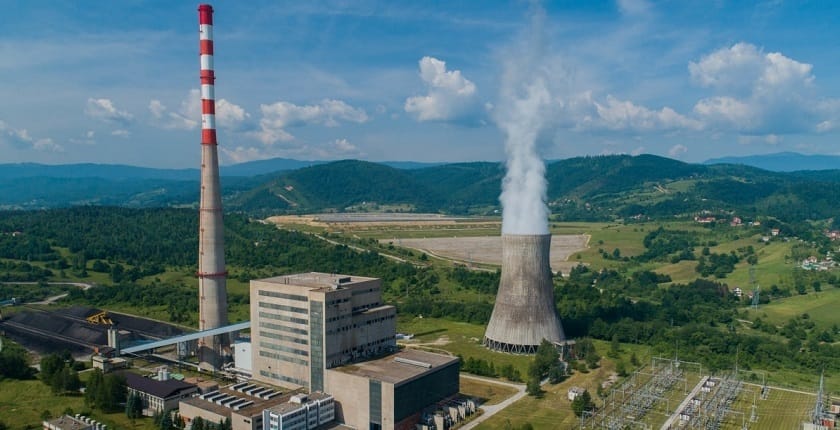
The Pljevlja power plant represents the biggest challenge Montenegro faces in its climate reform efforts.
Positivism
Although these challenges seem like very steep hills to climb for this mountainous country, Lisičić chooses to remain positive. Younger generations are increasingly concerned with the environment, he says; more often than not, they will support an ambitious green agenda in line with the EU accession chapters. Furthermore, he believes this is the time for the EU to step up its efforts: if the EU is serious about its willingness to welcome Montenegro into the Union, it should invest more in Montenegro’s institutional capacity to enforce the already well-aligned legal framework.
Montenegro has one clear advantage: its smaller size. While neighboring Albania faces a green transition that will likely lead to the closure of no fewer than four coal-fired power plants, Montenegro has only one. Indeed, the country needs more financial support, and its public debate on climate change should be intensified, but Montenegro’s green transition is likely much more manageable than that of its neighbors—making its ambition to join the EU in the coming years quite realistic. And finally, because of these factors, Montenegro has the potential to become a shining example for the region on its path toward EU membership.
Written by Jens Bosman (FMS) and Yesmin Ayadhi (IFG).
Click here for parts two and three, which focus on Albania and Ukraine, respectively.