Democracy
This series is written in collaboration with the International Foundation GroenLinks (IFG).
EU enlargement is back on the agenda. Following Russia’s full-scale invasion of Ukraine in 2022, and amid growing uncertainty about the United States’ role in Europe, EU leaders have increasingly emphasized the need to expand the Union. Closer cooperation with countries in Eastern Europe and the Western Balkans is seen as important for the continent’s security and independence.
Yet joining the EU is a complex process. Since the reforms in 2021, candidate countries must complete negotiations across 32 policy “chapters,” grouped into six thematic “clusters.” These reforms aim to bring national laws and institutions into line with EU standards. Much attention is usually given to the so-called “fundamentals” cluster, which covers areas such as the rule of law and public administration. However, other clusters are equally demanding.
Chapter 27, on Environment and Climate Change, is particularly challenging and complex. Its requirements are aligned with the European Green Deal, which aims for climate neutrality by 2050 and therefore requires major investments, strong administrative capacity, and coordination among institutions. It also has significant social consequences for candidate countries, especially those where jobs and energy systems still depend heavily on fossil fuels.
In this series, we examine how candidate countries are addressing the challenges posed by the climate chapters of the EU accession process. We analyze their progress on reforms and focus on the complex dynamics of the green transition, democratic legitimacy, and social change. In this article, we take a closer look at another candidate country: Albania.
Current Progress
Albania aims to conclude accession negotiations by 2027. This timeline involves a fast pace and a great deal of pressure. Part of the accession negotiations involves the necessary environmental reforms; Albania must meet nine major milestones in this area. For some of these milestones, the EU may grant a so-called “grace period,” meaning Albania is allowed to complete parts of the work after joining the EU. But climate action does not allow for such breathing room; no grace period is foreseen.
The European Commission’s 2025 report on Albania notes that “alignment with the EU acquis on climate remains limited, and no significant progress was reported in addressing climate change.” Although the report is largely critical, it does highlight a few limited positive developments. These include steps to bring Albania’s spatial data regulations more in line with EU standards, the completion of the National Geoportal—which improves access to geographic and environmental information—local climate adaptation plans in eight municipalities, progress on five river basin plans designed to improve water management, and some anti-corruption measures in environmentally sensitive cases.
Fact-finding mission
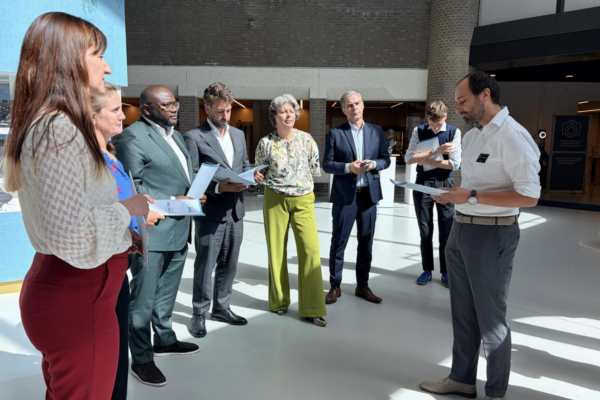
The Stockholm Environmental Institute (SEI), a research institute specializing in sustainable development, conducted a fact-finding mission in Albania in July 2025. This mission was requested by the Swedish Embassy in Albania. It conducted a detailed assessment of Chapter 27 and then cross-checked its findings with key stakeholders, including the Ministry of the Environment, the Prime Minister’s Office, the EU Delegation, and CEDA. SEI’s Bora Hajdini, describing the pace and expectations surrounding the process, said that her organization “also felt a lot of pressure” when they met with government officials during their visit, given the 2027 target.
After meetings with the government and the local EU delegation, SEI concluded that institutional coordination and administrative capacities remain weak in Albania—making not the implementation, but the enforcement of necessary EU reform policies the biggest problem. Hajdini analyzes the lack of enforcement capacity as a long-standing issue in Albania that is also widespread in the region, exacerbated by a heavy reliance on technical support from other countries.
Implementation and Enforcement
Nonetheless, there are positive signs. After the 2025 election, Albania established a separate Ministry of the Environment, which had previously been combined with the Ministry of Tourism. SEI views this separation as “a step in the right direction,” partly because tourism is “sometimes (…) controversial from an environmental perspective.” However, Hajdini warns that a new ministry does not automatically lead to better results: much of the work still depends on outside technical assistance and external projects. This means that the question of what will happen when that support ends remains.
SEI highlights one key problem that must be resolved for Albania to achieve its 2027 goals. It is not enough for funding to exist on paper; the country also needs the capacity to turn that funding into operational projects. Hajdini said they have heard this issue raised many times; Albania is “not well prepared when it comes to funding absorption capacity.” She warns that this will become even more apparent as the country moves toward larger EU funding programs. While alignment with EU legislation is progressing, actual implementation and enforcement are still lagging behind. Because of this, more attention is needed for administrative capacity, coordination between institutions, implementation, communication, and stakeholder engagement.
When asked about public perception, Hajdini noted that citizens’ enthusiasm for EU membership does not automatically mean they understand what accession requires. Albania may be “very much in favor of EU accession,” but SEI found that citizens’ awareness of what membership entails—especially the requirements of the environment chapter—is very low. That is why they call for “a strong narrative and communication strategies” that link reforms to tangible benefits such as economic growth, public health, and quality of life. Universities and private-sector actors can support this strategy by helping to translate technical policy goals into broader public awareness and engagement.
Looking Ahead
Hajdini also touched on a broader observation: in her view, “Chapter 27 has become so much more complex” than it was in earlier rounds of enlargement. She even raised the question of whether some existing EU member states would fully meet today’s standards. All in all, SEI’s message is straightforward: Albania’s 2027 goal may be achievable, but it will depend on whether the country can implement reforms in practice without needing ongoing external support to keep the process moving forward.
Written by Yesmin Ayadhi (IFG) and Jens Bosman (FMS).
Click here for parts one and three, which focus on Montenegro and Ukraine, respectively.